Yoshino Kakinoha-zushi | Nara
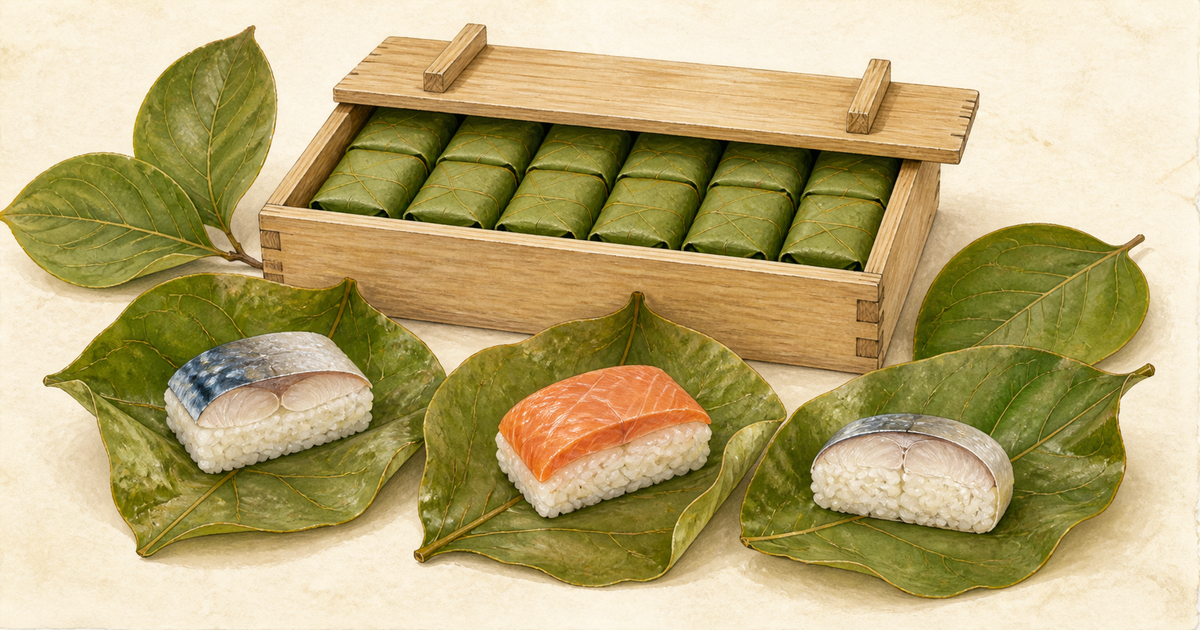
Yoshino kakinoha-zushi places thin salt-and-vinegar-cured mackerel or another fish on bite-size vinegared rice, wraps each piece in astringent-persimmon leaf and presses the packed box...
At a glance
| Name | Yoshino Kakinoha-zushi | Nara (Kakinoha Zushi) |
|---|---|
| Prefecture | Nara |
| Region | Kansai |
| Type | Pressed vinegared rice and cured fish individually wrapped in persimmon leaves |
What is it?
Yoshino kakinoha-zushi places thin salt-and-vinegar-cured mackerel or another fish on bite-size vinegared rice, wraps each piece in astringent-persimmon leaf and presses the packed box overnight.
Salt fish carried inland, leaves from a persimmon-growing region and summer-festival hospitality converged along Nara's Yoshino River. The leaf is normally removed before eating.
History and local context
A tradition links kakinoha-zushi to salted summer mackerel carried from Kishu in the mid-Edo period and served at festivals around Gojo, Oyodo, Shimoichi, Yoshino and Kawakami.
Wakayama's Ito area also wraps and presses mackerel and other toppings. South Kaga, Ishikawa, has a distinct style arranged on leaves and decorated with shrimp or colored seaweed before box pressing, so it is not identical to Nara's individual parcels.
Before buying, decide when you will eat it and whether to choose an ordinary short-life product or one sold frozen. Match the collection or delivery date to the package deadline and choose a quantity you can finish. Follow its storage instructions for the time and temperature during transport.
Tanaka’s ordinary kakinoha-zushi must be eaten by 20:00 on the third day including manufacture. Izasa also gives three days including manufacture, but some products expire on the purchase day. Check your package to make sure its deadline covers the day you plan to eat it.
The rice can harden when overchilled. Where refrigeration is needed in hot conditions, Tanaka suggests newspaper wrapping and a vegetable compartment with weaker cold air. Izasa’s shopping guide recommends wrapping or a resealable bag in the vegetable compartment. Follow the maker’s instructions for that product and avoid direct sun, heat and humidity; protecting rice texture does not extend the deadline.
Tanaka does not recommend freezing leftovers from ordinary products at home, and Izasa says its ordinary kakinoha-zushi cannot be frozen in a domestic freezer. A product sold frozen is a separate choice. For a later meal or a gift whose recipient cannot eat immediately, check frozen availability before ordering rather than planning to freeze an ordinary box.
For example, Izasa’s frozen five-variety, 20-piece kakinoha-zushi is designed for microwave preparation. Tanaka’s frozen-product FAQ says thawing methods differ by item and that thawed products should be eaten that day. Check the exact item’s label for storage temperature, packaging removal, wattage, quantity and thawing method; do not transfer one product’s microwave time to another.
How to enjoy it
Remove the persimmon leaf and eat the fish with the vinegared rice. A mixed box of mackerel and salmon lets you compare their fat, acidity and texture.
For hard rice within the stated deadline, Izasa suggests gentle microwave warming with the leaf still on. Ask the maker or follow the product instructions for the actual method. Warming does not make an expired or improperly stored product safe or restart its storage period.
Sources and further reading
Order from Japan
Search Rakuten Japan using the original Japanese food name. Search results and product pages may be available only in Japanese.
This section contains an advertising affiliate link to Rakuten Japan.